


Last week, the Office for National Statistics published the latest figures from the Annual Survey of Hours and Earnings, showing that care costs continue to rise faster than inflation, highlighting the importance of regularly reviewing long-term care costs for individuals receiving personal injury compensation awards, or who are under the Court of Protection.
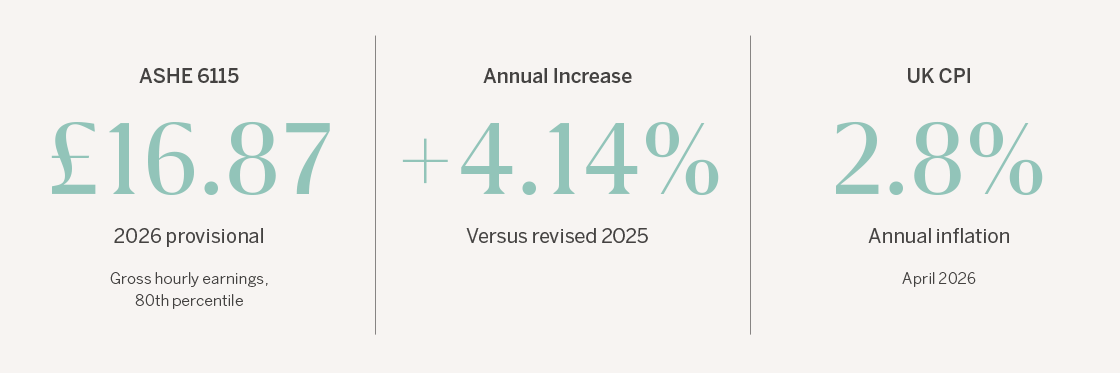
The latest figures from the Office for National Statistics (ONS), relating to April 2026, show that hourly earnings for care workers, home carers, and senior care workers (ASHE 6115) at the 80th percentile have increased to £16.87, compared with the revised 2025 figure of £16.20. This represents an annual increase of 4.14%, exceeding the UK’s Consumer Prices Index (CPI) inflation rate of 2.8% in April 2026 by 1.34%.
Why is ASHE important?
The Annual Survey of Hours and Earnings is published by the ONS and provides detailed information on earnings across different occupations in the UK.
Unlike traditional measures of inflation, such as CPI, ASHE reflects changes in earnings within specific occupations rather than the prices of everyday goods and services and is particularly relevant in personal injury and Court of Protection cases, where the ongoing cost of care can represent a significant proportion of an individual’s long-term expenditure.
The 80th percentile is frequently used as a reference point when assessing future care costs and calculating the annual adjustments to Periodical Payment Orders (PPOs), where payments are linked to the applicable ASHE measure and percentile specified in the court order.
CPI vs ASHE 6115: a widening gap
The latest figures demonstrate that care workers’ earnings continue to increase at a faster rate than general consumer prices.
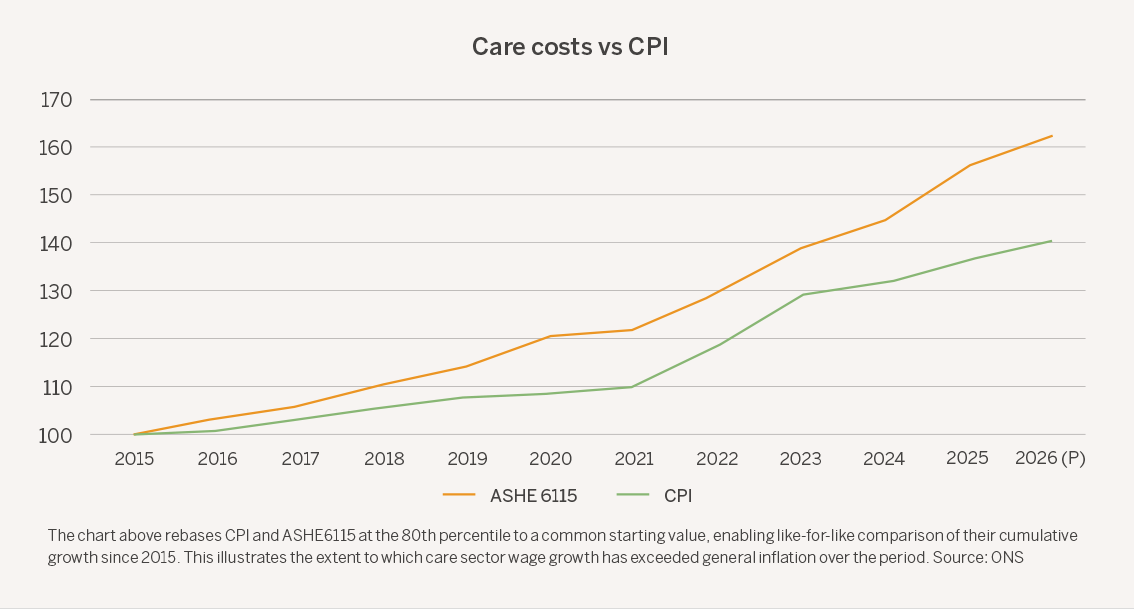
In recent years, the ASHE 6115 has outpaced CPI. This growing gap highlights the importance of being aware of and planning for future care expenditure, as it may continue to outpace headline inflation. It also reinforces the value of advice that remains flexible and adaptive as care needs, costs and wider economic conditions change.
For individuals requiring substantial levels of care, even relatively small increases in hourly costs can translate into significant additional annual expenditure. Over longer periods, these increases can materially affect the capital required to fund care throughout an individual’s lifetime.
It is important to recognise that ASHE measures employee earnings rather than the full cost of privately commissioned care, which can also be influenced by other factors including agency fees, employer costs and individual care requirements.
What does this mean for deputies and trustees?
For professional deputies, trustees and those responsible for managing compensation awards, the latest figures reinforce the importance of ensuring that investment portfolios and long-term financial plans adequately account for care cost inflation.
Where a compensation award is intended to meet care costs over several decades, relying solely on general inflation assumptions may underestimate the rate at which expenditure increases. This makes it particularly important to balance the need for accessible funds to meet ongoing expenditure, with an investment strategy designed to support the client’s long-term financial future.
Equally, for individuals receiving PPOs, it is important to ensure that annual adjustments are calculated accurately and in accordance with the terms of the relevant court order.
Regular cashflow forecasting and portfolio reviews can help identify whether an individual’s assets remain sufficient to meet their anticipated future needs, particularly where expenditure is increasing faster than originally projected.
How JM Finn can help
At JM Finn, our specialist Court of Protection and Personal Injury team works closely with professional deputies, trustees, legal advisers and families to help manage compensation awards and protect clients’ long-term financial security.
We recognise that every individual’s circumstances are different, particularly where an investment portfolio must support ongoing care costs following a life-changing injury.
Through active investment management, long-term cashflow forecasting and reviews of PPO calculations, we aim to help clients and those responsible for their finances plan with greater confidence as circumstances and costs evolve.
If you would like to discuss the implications of the latest ASHE figures, review an existing investment portfolio or arrange a PPO calculation check, please contact our specialist Court of Protection and Personal Injury team at cop@jmfinn.com.
Disclaimer: The ASHE 6115 figure is sourced from ONS Table 26.5a, “Hourly pay – Gross” at the 80th percentile and relates to April 2026. It remains provisional and may be revised. Annual CPI is based on April to April for each year.


